

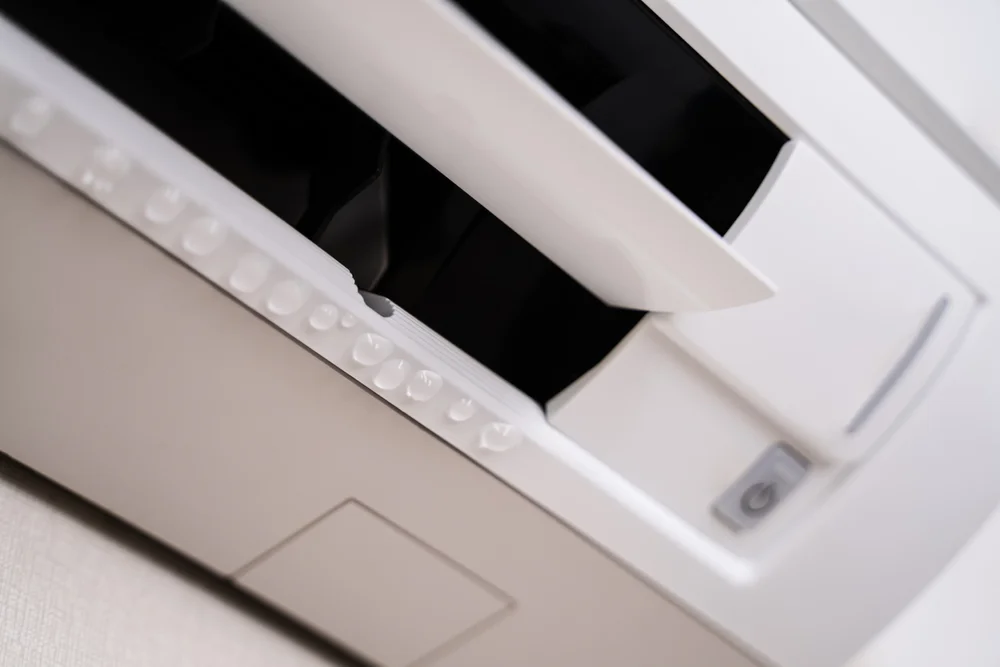
If your air conditioner is leaking, the real question isn't whether to repair or replace. It's whether the leak is water or refrigerant. Those two problems cost different amounts. Knowing which one you're facing tells you whether you need a $150 fix or a new system.
Most AC leaks are water, not refrigerant. NEXGEN sorts out what's leaking and when repair stops making sense compared to replacement.
If you're looking at a puddle or hearing a hiss from your outdoor unit, contact us at (820) 200-1614 to schedule an AC estimate before you spend money guessing.
Is It a Water or Refrigerant Leak?
Warm air passing over the cold evaporator coil (the indoor coil that pulls heat out of your air) condenses into water that's supposed to drain outside. That's the source of most leaks. Refrigerant moves through a sealed loop of copper tubing and should never escape.
Look for these differences to determine whether your system has a water or refrigerant leak:
- Clear, odorless liquid near the indoor unit – Almost always condensate water, not refrigerant.
- A hissing or bubbling sound near the outdoor unit – Points to escaping refrigerant gas.
- An oily residue around a coil or fitting – Refrigerant carries a trace of oil as it leaks.
- Ice on the coil or copper lines – Either problem can cause this, so ice alone doesn't tell you which one you have.
What Usually Causes a Water Leak
Water leaks account for most of our AC leak calls, and they usually trace back to the drainage path.
The drain line and pan tend to fail in a few predictable ways:
- A clogged condensate drain line – Algae, dirt, or mold blocks the PVC pipe, and water backs up into the drain pan until it spills over.
- A cracked or rusted drain pan – Older pans corrode with age, letting water seep straight through.
- A failed condensate pump – Attic or basement units rely on a pump, and a dead motor can cause rapid overflow.
- A frozen coil from a dirty air filter – Restricted airflow freezes the coil, and the melting ice overwhelms the pan.
Because these are mechanical problems, most water leaks are inexpensive to fix. That's why our technicians check the drain line and filter first on almost every leak call.
What Usually Causes a Refrigerant Leak
Refrigerant leaks are less common, but they matter more, because your system can't cool your home once levels drop.
The copper lines and coils typically fail from one of these:
- Formicary corrosion – Reactions between indoor pollutants, such as cleaning products, and the copper create microscopic pinholes.
- Vibration and wear – Lines rubbing against each other or a bracket slowly wear thin.
- A frozen coil from low refrigerant – Dropping pressure ices over the coil, and the melting ice creates a second, water-based leak.
A faint hissing sound near either unit is the clearest sign of refrigerant, and it isn't something to leave alone.
The Factors That Decide Whether to Repair or Replace
Your system's age and refrigerant type matter more than the leak itself.
Repair usually makes sense when:
- It's a water leak – Clogged drain lines, cracked pans, and failed pumps typically run $100 to $400 to fix.
- The unit is under 8 to 10 years old – Parts are still readily available, with plenty of life left.
- It's a small, accessible leak on a current R-410A system – An easily soldered leak is worth repairing, not replacing.
Replacement usually makes more sense when:
- The system still runs on R-22 – Production stopped in 2020, so refilling an older system is expensive and only temporary.
- The unit is past 10 to 12 years old – Central air conditioners typically last 10 to 15 years, and major repairs on an aging unit rarely pay off.
- The coil itself is leaking – A full coil replacement often runs $1,500 to $3,500 or more, which starts to approach the cost of a new system.
Multiply your unit's age by the repair estimate. A 12-year-old system needing a $500 repair works out to $6,000, past the $5,000 point where replacement wins the math.
That's what an AC estimate is for. We'll tell you which bucket your unit falls into and match any comparable quote from another licensed company.
Know Before You Spend
A leaking AC isn't automatically a dying AC. Most leaks start with a clogged drain line or a dirty filter, far cheaper fixes than full replacements. Refrigerant leaks deserve more caution on an aging R-22 system, but your unit's age and repair cost still tell you more than the leak alone.
Our technicians at NEXGEN inspect the whole system before recommending either option.
Call (820) 200-1614 or schedule online for an AC leak diagnosis anywhere in Southern California, so you know whether repair or replacement is the right move before you spend a cent.